Mining-to-AI Conversion Services
Helping Bitcoin miners pivoting to AI
Used ASIC values drop fast. Every week you wait, the fleet is worth less. ACS maximizes resale value and moves volume with storage, service, and resale under one roof.
500,000+ ASICs processed for the world’s leading mining companies








A fleet coming offline runs through six stages
They run in this order because each one needs the last. You can’t consolidate what you haven’t inspected. You can’t refurbish units that aren’t whole yet. You can’t time a market with inventory that isn’t finished.
Skip a stage or run them out of order and you redo work, or you leave money on the table. The return you get is capped by the earliest stage you skipped.
Inspection
Unit-by-unit diagnosis. This is the stage that creates information, not sale value. The other five depend on it.
Consolidation
Whole, sellable units rebuilt from partial ones. Hashboards, control boards, PSUs, and chassis recombined across the fleet.
Repair
Board-level repair on failed units: diagnose to the component, rework, test under load, verify.
Refurbishment
Working units brought to sellable condition. Cleaning, thermal paste, fans, cosmetic remediation, firmware, final test.
Storage
Finished inventory held in a controlled facility until the right channel and the right moment.
Consignment
Units placed into the right channel, and the sale managed. Everything upstream gets the iron ready. This is where it sells.
Before the six stages
Decommissioning & logistics
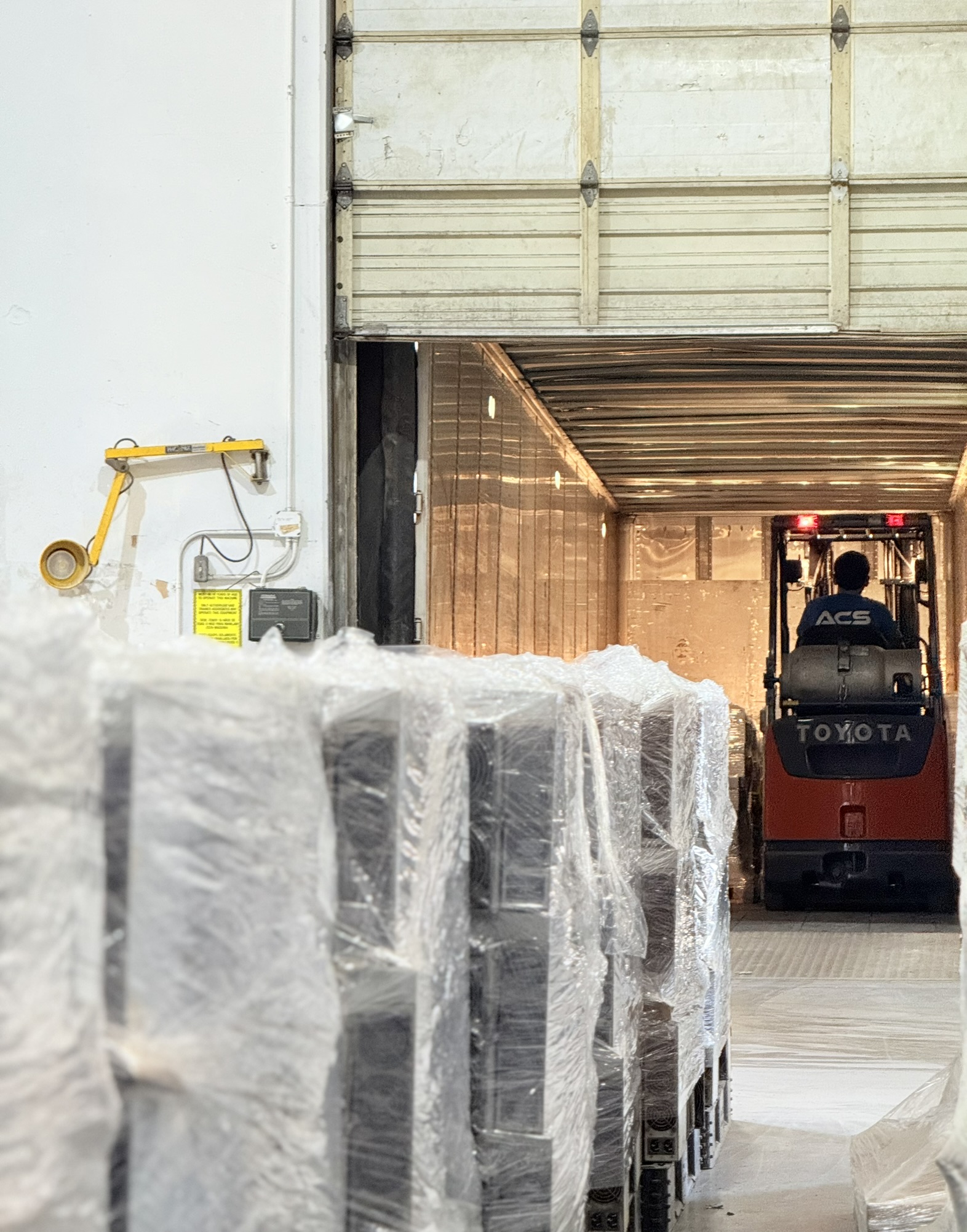
Decommissioning is where assets most often get damaged, lost, or poorly documented. The fleet has to clear the floor on the conversion schedule, not on the schedule that would maximize recovery. That pressure is what turns an orderly removal into a write-off.
What we do
- Coordinated shutdown sequencing that preserves miner configuration and avoids firmware corruption
- Professional unracking and anti-static packaging for every unit
- Serial number and MAC address scanned at removal, matched to inventory before anything leaves the floor
- Freight coordination across insured LTL and FTL carriers, tracked to Dallas or a destination you specify
- Condition-noted receiving report on arrival, with any pre-existing damage flagged and photographed
- Chain-of-custody documentation available throughout transport
What it produces
- Your asset count stays accurate from site to warehouse
- No weeks lost reconciling missing units, unlogged damage, or mismatched serial numbers
- The floor clears on the conversion schedule without the fleet’s value clearing with it
- Removal is sequenced and planned rather than improvised at the loading dock
The ACS difference
Disputes get resolved with documentation, not memory
Every asset moving through ACS logistics is tracked by serial number, photographed at packaging and again at receipt, and reconciled against the original manifest. Undocumented decommissioning is what creates the disputes that take weeks to settle. We have run large-scale decommissions across container fleets, purpose-built facilities, and temporary structures. The sequencing is planned work, not an improvised checklist.
Stages one and two
Inspection, cleaning & consolidation
Consolidation is what separates a lifecycle partner from a disposition vendor. It only works on top of real inspection data.
A fleet that has been running for years is quietly full of partial machines. One board short. One PSU short. Cannibalized during an outage and never made whole. Records drift with the hardware. That is normal site life. It is also why inspection comes first.
What we do
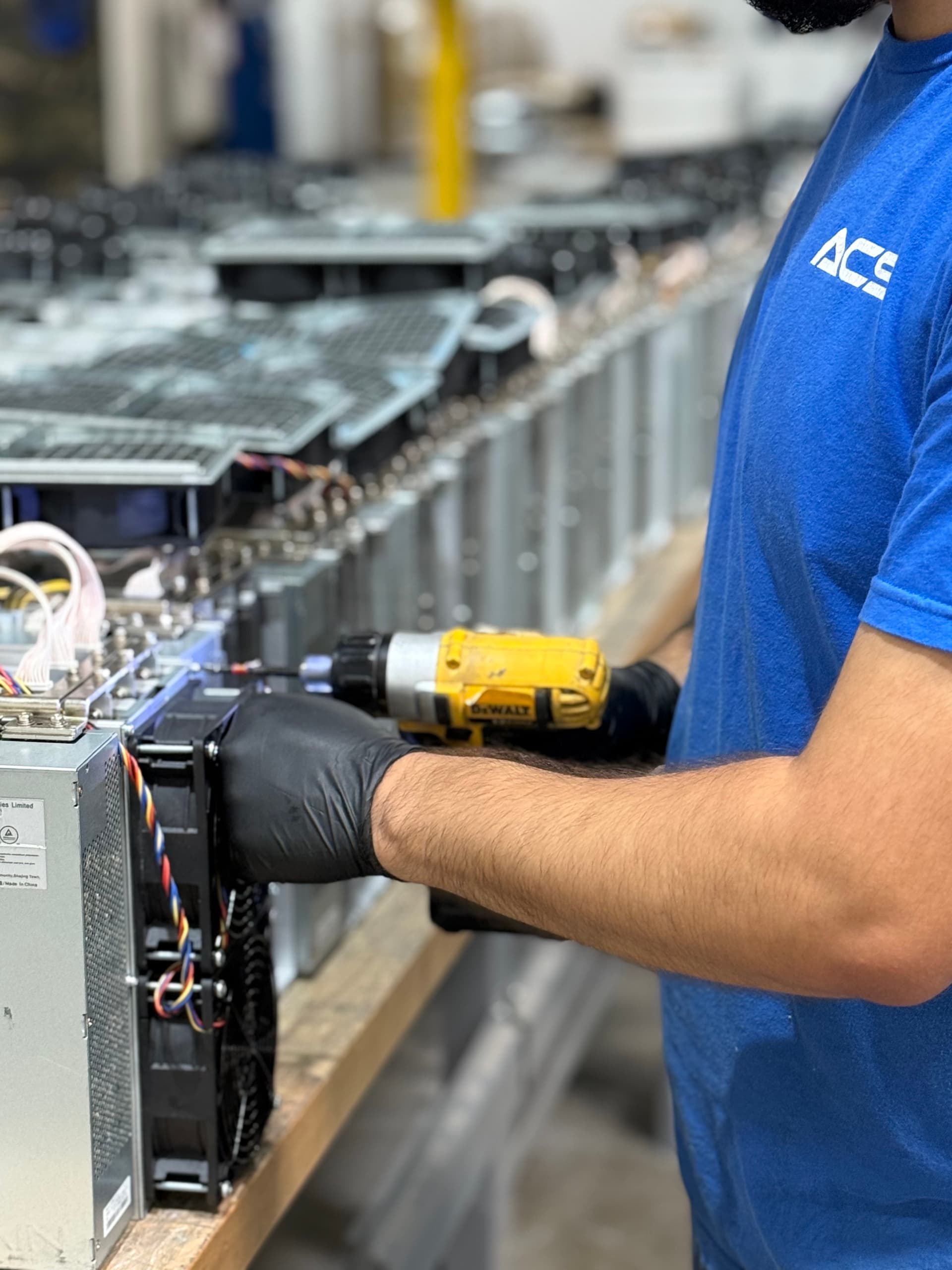
- Consolidation across the fleet, and across sites where the fleet spans more than one. Hashboards, control boards, PSUs, and chassis recombined into whole units
- Flying probe diagnostics on every hashboard, identifying component-level faults rather than a functional pass or fail
- Power supply testing under load, and fan RPM measured against OEM specification
- Firmware version and configuration logged, with custom firmware identified and flagged
- Intake cleaning, so inspection reads true condition instead of field grime
- Condition grading from A to D with a formal per-unit report, exportable, and batch reporting for large fleets
What it produces
- Whole, sellable units built out of inventory that had none. The partial population recovers unit value instead of parts value
- A real condition split, rather than the believed condition your records describe
- Every decision downstream is priced against a per-unit record instead of a guess
- What a bulk buyer knocks off for your unknowns is routinely larger than the cost of resolving them. That discount goes away once the unknowns are gone
The ACS difference
Consolidation is the hardest stage to buy
Recombining partial units needs board-level repair capability and diagnostic depth. You have to know which boards are dead versus repairable, which combinations are compatible, and what a rebuilt unit will actually do under load. Brokers do not have that. ITAD firms do not have that. Auction houses are not in the business of having it. Our inspection methodology was built for the repair facility, so it produces repair-quality fault data rather than a visual grade from a cursory look.
Stages three and four
Repair, repaste & refurbishment
Repair economics in a transition are not repair economics in an operating fleet. In an operating fleet you repair to restore hashrate. In a transition you repair to a resale threshold. The question is not whether a unit can be fixed. It is whether fixing it costs less than what it adds to the sale price. Refurbishment then closes the gap between a unit’s real condition and what a buyer sees.
What we do
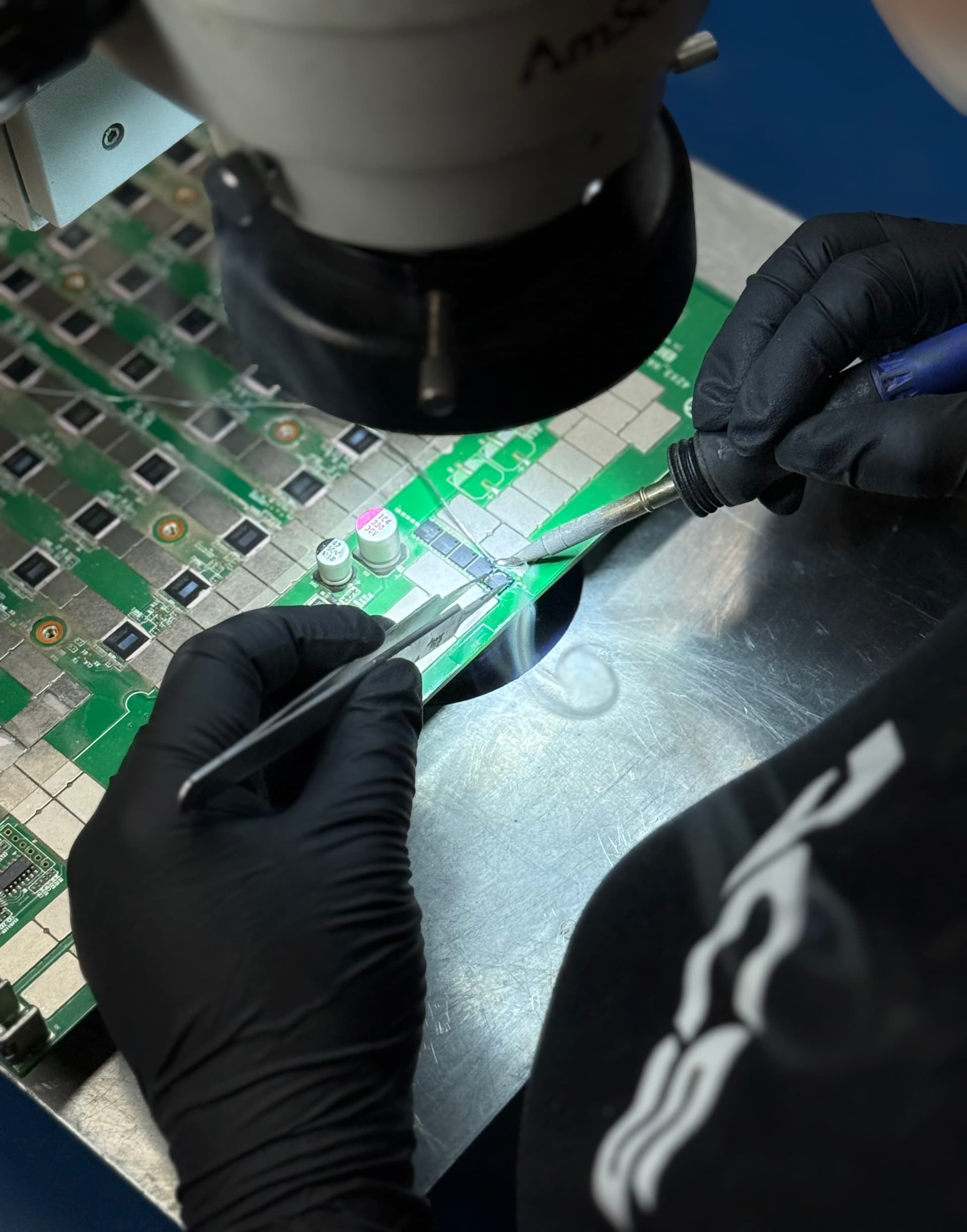
- Flying probe diagnostics isolating ASIC chip failures, capacitor faults, and PCB trace damage
- Automated ASIC removal and replacement by pick-and-place, eliminating manual error on high-density boards
- Bitmain Ant Training Academy certified technicians on every repair line
- Per-board documentation: fault identified, repair performed, test results, technician ID
- Deep cleaning by compressed-air and ultrasonic process, clearing the dust, salt, and thermal debris that field operation leaves behind
- Fan replacement wherever RPM has degraded below OEM spec, not only where a fan has already failed
- Thermal paste replaced on every heatsink contact point, and firmware restored to current stable OEM
- A 24-hour burn-in at target hashrate before any unit is graded, listed, or returned to service
What it produces
- Failed units move from the zero-value column to the sellable column. In a retired fleet that group is rarely a rounding error, because failures accumulate toward end of life
- Boards that other shops write off return to full specification
- Working units stop absorbing a discount disproportionate to their actual condition
- Units graded B or C frequently reach A classification after full refurbishment
The ACS difference
Component-level repair, and knowing where to stop
Most field repair replaces the whole board. We diagnose and repair at the component level, against fault patterns catalogued across more than 500,000 ASICs processed since 2021. That volume is what lets our diagnostic models recognize failure modes accurately at fleet scale.
The other half of the discipline is restraint. Older-generation units with poor J/TH efficiency, heavily damaged chassis, and anything carrying immersion or contamination history often cost more to bring up than the improvement returns. Knowing where to stop is part of the stage.
Stages five and six
Storage, resale & consignment
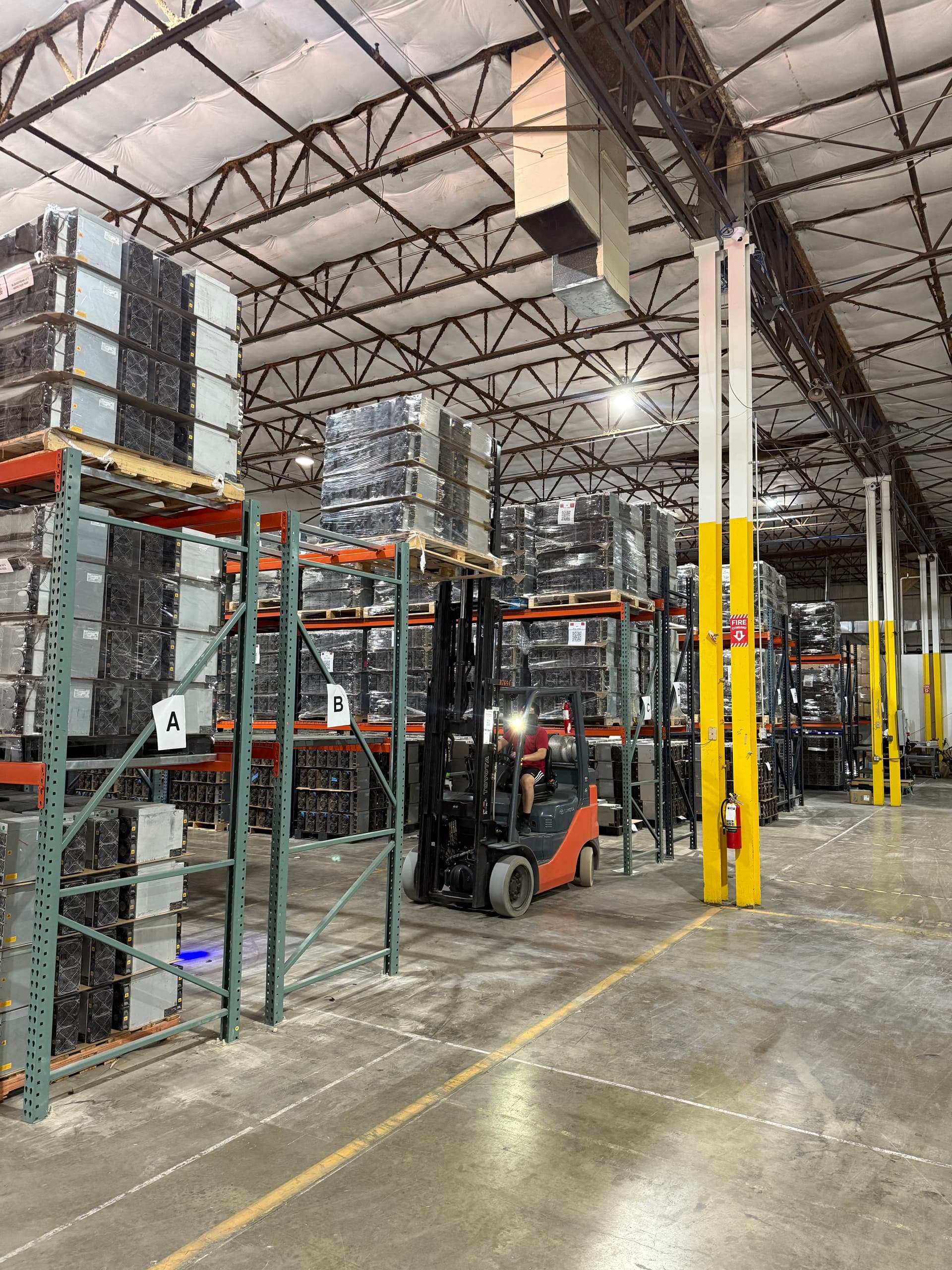
Used ASIC prices move with hashprice, difficulty, and new-hardware release cycles. Site conversion schedules move with construction and power. Those two calendars are unrelated. Without storage you sell on the construction calendar, into whatever market exists on your clearance date.
What we do
- Climate-controlled storage with temperature and humidity monitored continuously
- Insured holding, with documented valuation at intake
- Per-unit inventory. Serial number, model, condition grade, storage location, with live client portal access rather than manual reports
- Timestamped intake and outbound condition photography on every unit
- Listings carrying the ACS condition report, so buyers receive verified diagnostic data rather than self-reported grades
- An established buyer network spanning operators, hosting providers, resellers, and institutional and international buyers
- Managed listing process: photography, specification documentation, and buyer inquiry handling
- Market pricing guidance drawn from current secondary market data, with proceeds settled on your timeline
What it produces
- Timing control. You sell on the market’s calendar instead of construction’s
- Channel matching. Retired ASICs have no single market, and matching unit to channel is the difference between a price and the best available price
- Stored units list immediately, with no re-intake, no re-transport, and no delay between storage and sale
- Realized value, fully documented. The number that ends up on your side of the ledger
The ACS difference
Revenue share, because the incentive question is a fair one
Consignment is structured as revenue share. If a partner tells you your fleet is worth more after their process, the fair response is that they would say that. Revenue share means our number and your number are the same number.
The same honesty applies to holding. Storage costs capital and depreciation against a curve that generally trends down, so sometimes selling immediately is the right call. A partner who always recommends holding is reading their own incentives rather than the market.
One contract, one accountable party
The six stages exist separately in the market. What is rare is running them in sequence without a handoff between vendors at every step. Each handoff re-establishes chain of custody. None of them owns the outcome.
ACS runs inspection through consignment under one contract and one accountable party. The same team that clears your floor is the team that grades, repairs, stores, and sells. That is the contrast with a chain of handoffs.